Leave Your Message

10 Tips for Choosing General Purpose Fuses

Choosing General Purpose Fuses is a small decision with real consequences. A fuse must interrupt a fault safely, yet allow normal startup current to pass. The label alone is not enough. Voltage rating, current rating, interrupting capacity, time-current behavior, and environmental conditions all matter.

NFPA’s report Electrical Fires, analyzing U.S. data from 2015–2019, estimated an annual average of 32,620 home structure fires involving electrical distribution or lighting equipment. These incidents caused about 425 civilian deaths and $1.3 billion in direct property damage each year. The report does not isolate fuse failures, so it should not be read as evidence that fuse choice alone prevents fires. It does show why careful protection design deserves attention. NFPA research analyst Marty Ahrens documented these estimates; his work offers a sobering reminder that electrical protection depends on sound, verifiable decisions.

A practical selection principle is simple: “Match the fuse to the circuit, then check the fault conditions.” This is an editorial summary, not a verbatim quotation from Ahrens. For a real design, compare manufacturer time-current curves and confirm the available fault current before selecting a part. A fuse that fits the holder may still be unsuitable. That detail is easy to miss.

This guide introduces ten checks for choosing General Purpose Fuses, from load characteristics and inrush current to coordination, ambient temperature, and replacement availability. It also flags a common weakness in quick selections: relying on nominal amperage alone. The right choice is specific to the application, and sometimes the available information is incomplete. Verify it before installation.
10 Tips for Choosing General Purpose Fuses

Understanding the Purpose and Operating Conditions of a General-Purpose Fuse

A general-purpose fuse is an overcurrent device: its element melts when current and time create enough heat. It can interrupt sustained overloads or short circuits, but it cannot correct poor wiring or every equipment fault. Check rated voltage, current, interrupting capacity, and time-current behavior against the actual circuit. The IEC 60269 series specifies requirements for low-voltage fuses; the exact fuse duty still matters. “General purpose” is not a substitute for checking the application. NFPA’s Home Electrical Fires report, covering 2015–2019, linked electrical failures or malfunctions to an annual average of 430 civilian deaths and $1.3 billion in direct property damage. These figures describe a broad hazard, not fires a fuse alone could have prevented. That distinction matters.

Operating conditions change fuse performance. Record the normal load, motor or transformer startup surges, ambient temperature, and heat inside the enclosure. A fuse selected only from steady-state current may open during a brief inrush. Increasing its rating to stop nuisance openings can leave conductors under-protected. Compare the fuse time-current curve with the load profile, and confirm that its voltage and interrupting ratings suit the installation’s prospective fault current. A cabinet beside a hot process line may behave differently from a cool test bench. Measure, rather than assume. Field conditions are messy, and a calculation can miss them; qualified review is especially valuable when duty cycles or fault levels are uncertain.


Matching Voltage, Current, and Interrupting Ratings to the Circuit

Choose a fuse voltage rating equal to or higher than the circuit’s maximum voltage. Check whether the circuit is AC or DC; ratings are not automatically interchangeable. A panel may read 120 volts during normal operation, but confirm the system’s actual limits. Small detail, big consequence.

Match the ampere rating to the protected wire and the equipment’s normal operating current. A motor drawing extra current at startup may need a time-delay fuse, while a sensitive electronic circuit may require a faster response. Check the fuse’s time-current curve and account for temperature and enclosed spaces. A rule of thumb can mislead. Never increase the fuse rating just to stop nuisance openings; the wire may overheat before the fuse responds. Then check interrupting rating: it must meet or exceed the prospective fault current at the fuse location. This is the current the fuse may need to stop safely during a short circuit. If that value is unknown, consult the equipment documentation or a qualified electrician. Verify all three ratings together. They are easy to check individually, yet a mismatch in any one can leave a circuit inadequately protected.

10 Tips for Choosing General Purpose Fuses — Matching Voltage, Current, and Interrupting Ratings to the Circuit

Tip What to Check Practical Guidance Before You Select
1. Match the voltage rating Fuse voltage rating and circuit voltage Choose a fuse with a voltage rating equal to or greater than the circuit voltage. For DC circuits, confirm the fuse is specifically rated for the DC voltage; AC and DC ratings are not automatically interchangeable. Check the fuse datasheet for its AC or DC rating and the circuit’s maximum operating voltage.
2. Check the interrupting rating Available fault current at the installation point The fuse’s interrupting rating must be at least as high as the maximum prospective short-circuit current at its location. This rating describes the fault current the fuse can safely interrupt under specified conditions. Use a fault-current calculation or equipment documentation, and compare it with the fuse’s published interrupting rating.
3. Size for the load and conductors Normal current, conductor ampacity, and applicable rules Start with the load’s expected operating current, then select a fuse rating that protects the circuit conductors and complies with applicable electrical codes. Do not assume the load’s nameplate current alone determines the correct fuse size. Check load documentation, conductor ampacity, and the rules that apply to the installation.
4. Account for startup current Inrush current and its duration Motors, transformers, lamps, and capacitive power supplies can draw a brief current surge at startup. A time-delay fuse may tolerate an appropriate surge, but its time-current curve must still provide suitable fault protection. Review measured or specified inrush magnitude and duration against the fuse’s time-current curve.
5. Choose the right operating speed Fast-acting or time-delay response Fast-acting fuses respond quickly to overcurrent and may suit sensitive components. Time-delay fuses tolerate defined temporary overloads. Neither type is universally preferable; choose based on the load and required protection. Compare the fuse’s time-current characteristics with normal operating and fault conditions.
6. Consider temperature and derating Ambient temperature, enclosure, and fuse-holder limits High ambient temperature, restricted airflow, and heat from nearby components can affect fuse operation and allowable current. The fuse, holder, and connections may each have temperature or current limits. Follow the manufacturer’s derating guidance and check the holder’s ratings in the actual installation conditions.
7. Verify the fuse class or type Application, construction, and applicable standard Fuse classes and types can differ in dimensions, performance, and intended use. Select a fuse approved for the application and compatible with the equipment’s specified fuse class or type. Confirm the required class or type in the equipment documentation and applicable standards.
8. Check physical compatibility Size, mounting, terminals, and holder A fuse must fit its holder correctly and have suitable terminal and mounting arrangements. Similar-looking fuses may not have the same electrical ratings or interrupting capability. Check dimensions, terminal style, holder compatibility, and all required ratings—not just appearance.
9. Coordinate with upstream protection Selectivity and time-current behavior Where continuity of service matters, coordinate the fuse with upstream and downstream protective devices. Proper coordination can help limit an outage to the affected part of the circuit, but depends on the devices and fault levels involved. Review time-current curves and manufacturer coordination data for the complete protection scheme.
10. Replace like for like—and investigate failures Ratings, cause of operation, and replacement procedure Replace a fuse only with one that meets the equipment’s specified voltage, current, interrupting, speed, and class or type requirements. A fuse that opens may indicate an overload or fault; fitting a higher-rated fuse without reassessing the circuit can remove necessary protection. De-energize equipment as required, identify the cause, and follow the equipment maker’s instructions and safety procedures.

Comparing Fuse Types, Speed, and Time-Current Characteristics

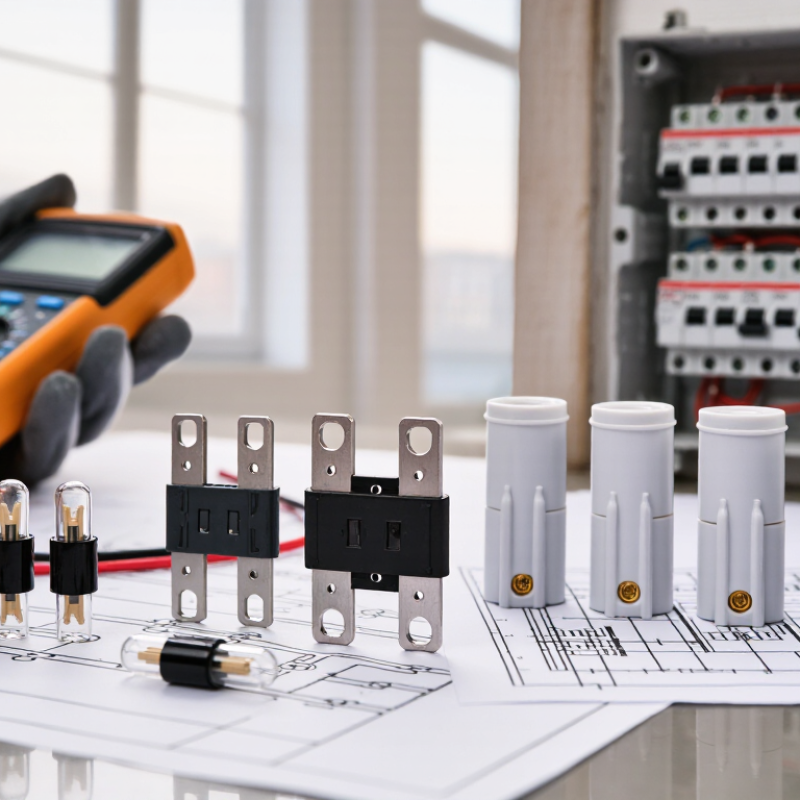
General-purpose fuses differ in construction and response. Cartridge fuses are common in control panels and equipment; glass bodies allow a quick visual check, while ceramic bodies can offer greater interrupting capacity. Blade-style fuses suit many low-voltage circuits. The package matters, but ratings matter more. Match voltage, current, and interrupting capacity to the circuit and equipment documentation.

Speed describes how quickly a fuse responds to excess current. Fast-acting types can protect sensitive components, but may open during brief startup surges. Time-delay fuses tolerate short inrush currents from motors or transformers. They are not simply “slow” fuses. Their time-current curves show how long they may carry different overload levels before opening. Read the curve at the actual fault or startup current.

Curves help compare fuse types and coordinate upstream and downstream protection. A downstream fuse should generally clear a fault before the upstream device, though real systems can complicate that goal. Check tolerances, ambient temperature, and neighboring devices. Small details count. A warm enclosure can shift performance, and a neat-looking curve is not a guarantee. I would avoid choosing by amperage alone; it is an easy shortcut, and sometimes the wrong one. Verify selections against the manufacturer’s published data and have a qualified professional review uncertain applications.

10 Tips for Choosing General Purpose Fuses: Comparing Fuse Types, Speed, and Time-Current Characteristics

Use the time-current curve to check how quickly a fuse may open at different multiples of its rated current. The curves below are illustrative generic trends, not guaranteed specifications; actual behavior varies by fuse design and must be verified against the specific manufacturer’s datasheet. When selecting a fuse, check rated current and voltage, fuse type and speed, interrupting rating, operating environment and temperature derating, applicable safety standards, and coordination with other protective devices.

Checking Dimensions, Mounting Style, and Environmental Suitability

A fuse can fit electrically and still fail to fit the equipment. Measure the body length, diameter, and terminal spacing against the holder, not just an old fuse. A few millimeters matter. Check the drawing for tolerances, since listed dimensions may not show the full shape of end caps or clips. A near match can sit loosely, heat up, or be difficult to remove.

Mounting style matters just as much. Confirm whether the design uses clips, a panel holder, a circuit-board footprint, or an enclosed fuse carrier. Check access for replacement and make sure nearby wires cannot press against the fuse. For a panel installation, verify the cutout size and available clearance behind the panel. It sounds obvious, but this detail is easy to overlook.

Environmental conditions can change how well a fuse performs. Review the specified operating temperature and any required derating; a hot enclosure may reduce the usable current. Consider vibration, moisture, dust, and exposure to cleaning agents. A sealed holder may help in damp or dusty areas, but only when its ratings suit the application. Read the fuse and holder datasheets together. I still find that pairing details deserve a second look.

Verifying Safety Standards, Availability, and Replacement Requirements

A general-purpose fuse should match the equipment, not just fit the holder. Check the specified current and voltage ratings, interrupting capacity, and time-current characteristics against the equipment documentation. Read the markings on the fuse carefully; small print can be easy to miss under poor lighting. A part that looks identical may behave differently during a fault.

Verify that the fuse carries safety approvals relevant to the equipment and the place it will be used. Do not assume a familiar symbol covers every application. If the documentation is unclear, ask a qualified technician or the equipment supplier before buying. Availability matters too. Check whether the exact specification is stocked locally, and keep a small, properly stored reserve for maintenance. That can reduce delays. Still, choosing a substitute only because it is readily available can create a mismatch.

For replacement, follow the equipment maker’s stated requirements and compare every rating, not just the amperage. Never install a higher-rated fuse to stop repeated failures; investigate the cause instead. Keep the old fuse. Its markings can help confirm the required type, but they are not a substitute for the manual. Record the replacement part and date. It is easy to overlook this detail during a busy repair, and that can make the next service call harder.